Tuesday, October 20, 2020

Wacky Weather! Freaks of the Storm: From Flying Cows to Stealing Thunder, by Randy Cerveny

Freaks of the Storm is a book I acquired a while back--from my late sister's collection, I think. We both enjoyed reading about marvelous phenomena. These "true weather stories" are interesting and amazing. And short! They make for a fun, brief little read. Each of the chapters covers a different weather aspect, such as tornadoes, lightning, hail, rain, etc. But there are also chapters for especially freakish weather events, grouped together at the end. One such chapter is titled "Oddest Weather Extremes."

I've been enjoying reading this book and I'm learning a lot about weather as a consequence! For instance, I now know what relative humidity is as well as dew point. He also gives advice in each chapter on how to deal with and survive severe weather. That is very useful information. 
Randy Cerveny

The writer is a professor of Geology at Arizona State University. If you want to read more about him, here is a website you can explore: Geology ASU.

Monday, June 18, 2018

Empress Min

Anchee Min, taken from her website
I'm very glad I finally got around to reading Empress Orchid, by Anchee Min. This was a very good book. I learned a lot about China and what it was like for the aristocracy in the mid-19th century, when China was forced to open their country to the world. The writer includes a great deal of history in her fictionalized autobiography of China's last empress, Tzu Hsi (nicknamed Orchid), of Manchu heritage. That was only one of the things I learned from this book: that Manchu was a particular type of Chinese ethnicity, different from what the author refers to as "Chinese."

But there was so much historical material in this book, it became a bit overwhelming at times and I must confess that I fast-forwarded through some of the more detailed sections. But the book wasn't just about China--it was also about the West and its fraught relationship with the East, in particular the British and their imperialistic designs, all of which seem to have to do (as ever) with money.

And perhaps the boldest thread that weaves through this book is the fate of women, not just in China, but in the world at the time. Empress Orchid--concubine, mother, leader--had a great deal of power at a time when women were not expected (or allowed) to wield power. In fact, most of the men in her life tried desperately to wrest it away from her. That they did not succeed is a testament to her strength and intelligence (some would say cunning).

The author is obviously intending to present a sympathetic portrait of this historical figure. Reading Wikipedia accounts I obtained a different, ostensibly more balanced picture. China has in the past century portrayed Tzu Hsi as evil--she is, after all, a figure from their imperial past that they were trying to vilify during the early years of Communism. Recently, however, she is enjoying a more positive reputation as a strong leader during a difficult time for China, when it was opened for the first time in centuries to the modern world. China learned the hard way that they were weak, decadent and insular--all qualities that left them vulnerable to exploitation and attack by Western countries.

This book was not only a good history lesson, however. It was also a good story, suspenseful and gripping. I found myself wanting to find out how Orchid was going to get her way--would she succeed in surviving? And I found myself caring about what happened to her and the people she cared about. I was sympathetic to her secret desire to return to her Manchurian roots, to ride with her husband into the countryside, to live the life of a nomad. Whether or not the real woman held such dreams is not clear, but reading about them made her more human and her plight--and that of her country--more sympathetic. Of course, making readers care about a protagonist is the mark of a good novelist--Anchee Min is definitely that. She has written other books--I may check them out.

An enjoyable book--I recommend it highly.

Next: an "M" book I somehow succeeded in avoiding when I was in high school: Moby Dick, by Herman Melville.

Sunday, April 8, 2018

The Progress of Fiction

Alice Munro
taken from IMDB
I've always enjoyed Alice Munro's stories. They're about ordinary people, usually women, dealing with the circumstances of ordinary life. They're quiet stories, generally, with little to no "action," as we've come to think of it. The stories in her 1987 collection, The Progress of Love, are no exception.

However, having read these stories several months ago, I cannot recall a single one of them, though I do recall enjoying them. Maybe that's a good thing--the mark of a story that seems to be about people you know, that fades into the background of your life. I guess I'll have to read them again. I'm looking forward to it!😉

The Bone Detective

Robert Mann
taken from William & Mary University Alumni Site
Dr. Robert Mann, the author of Forensic Detective: How I Cracked the World's Toughest Cases, is a forensic anthropologist and "director of the Forensic Science Academy at the Central Identification Laboratory in Hawaii, the largest forensic skeletal lab in the world." It is where they work to uncover the identity of remains of U.S. military members killed in wars. But he's also worked for the Smithsonian and the Memphis morgue. The book describes what he considers to be his most interesting cases. And indeed they are interesting.

Chapters in this book deal with a range of situations requiring forensic detection: from Jeffrey Dahmer's first victim, to the tragedy of 9/11, to the Body Farm, to the jungles of Vietnam. I'd like to say I have a favorite, but all were fascinating and worth reading.

I recommend this book highly to anyone interested in forensics or detective fiction or non-fiction.

The Wright Brothers Flies Right!

First Flight,
taken from Wikipedia
The Wright Brothers was an excellent book--no surprise, I'm sure, to McCullough's many fans. Everyone thinks they know something about these icons of aviation, but the mark of a truly great book of popular history, especially a biography, is that when you're finished reading, you know much more than you ever imagined you could about the book's subject.

This book was rich and meaty, filled with details about the two brothers, their family, their business and their neighborhood. McCullough managed to make a well-known and seemingly simple story complex, nuanced, and even suspenseful. It was amazing to me that at each turn of events in the saga of first flight, I was worried about how it was going to come out. And yet all of it had already taken place long ago!

Not only were there many facts, but there were documents and photos, letters and diaries to support the facts given. And McCullough didn't overstep the natural boundaries of non-fiction by venturing off into imagining thoughts and feelings he was not privy to, as many non-fiction writers will do. Instead, he qualified his speculation about what was not evident, basing his opinion on what was known about the brothers.

Because I felt as if I'd gotten to know these people, I was sad by the end of the book when I learned how they died. That's as it should be for a great biography. Well done, David! I'm looking forward to your next book.

Monday, January 8, 2018

Deserts, Poetry, and Flight

Carrying on with the "M" authors list, I next delved into two books: one is by James A. MacMahon, a professor of Ecology at Utah State University, entitled Deserts: A National Audubon Society Nature Guide. The other is an anthology of 20th century African American poetry, edited by Clarence Major, called The Garden Thrives.

James A. MacMahon
Deserts is mainly a reference work containing many images and descriptions of geographical and geologic features, flora and fauna to be found in the four major deserts of the United States--the Great Basin, the Sonoran, the Chihuahuan, and the Mojave. The introduction is extensive, though; from it I learned a great deal about what constitutes a desert and how plants and animals adapt to the harsh climate in which they make their home. Before I started this book, for instance, I was unaware that there are several types of sagebrush, and that at least one animal, the sage grouse, is almost totally dependent on that bush for its food, shelter, nesting materials, cover and concealment. In fact, I was so intrigued that I looked up the bird on the internet and found a fascinating National Geographic special that came out about a year ago. It can still be found at YouTube: The Greater Sage Grouse. I recommend viewing it. The bird is beautiful as well as clever! And if you're planning a trip to an American desert in the future, or even just want to learn about deserts, I highly recommend buying this Audubon field guide.

Clarence Major
While learning about deserts, I was also reading the poetry anthology with much interest. It contains over 100 African American poets of the 20th century, most of whom I had never heard of before. So it was an enjoyable experience to discover so many wonderful poets. I plan to learn more about many of them. One of the poets of whom I had heard is the famous Harlem Renaissance poet, Jean Toomer. One of his poems, "Reapers," appeared in his novel Cane. It was such a powerful poem I decided to make it into a song. I read Cane a while back; you can read my review of the book at this post: October 6, 2013.

David McCullough
The "M" book I'm currently reading is the biography of the Wright brothers by one of my favorite biographers, David McCullough. It's titled simply, The Wright Brothers, and it mainly covers their invention of the airplane and its aftermath. It's beautifully written, as are all McCullough's books. I read his book 1776 back about 10 years ago and enjoyed it very much, so I recommend this book highly. I'll have more to say in the next post!

Monday, December 25, 2017

His Middle Name

The cover photo of Michael Moore's autobiography, Here Comes Trouble, shows a very cute little boy: the author when he was probably around three years old. I'm sure the publisher chose this image because Moore looks so innocent, unlike the crafty fellow he later becomes.

This book was quite entertaining, though sometimes it seemed the stories he told about his life were just a bit fictionalized--they fit so nicely into a story format. But for someone who tells stories for a living, that's to be expected. And for the most part, the stories seemed self-serving, even if true. But what autobiography isn't self-serving, after all?

I learned something about Michael Moore's early life: that he came to film making late in his career and somewhat by accident. What he really was for most of his adult life (and some of his adolescent life) up to that point was a rabble-rouser, a muck-raker, and yes, a trouble maker. That he turned that talent for stirring things up into a lucrative career while also providing a public service is commendable and pretty amazing.

As I say, I enjoyed the book. It was well written and interesting--a fast read. I'm looking forward to the second installment that starts with the release of Roger and Me, and comes up to the present, whenever that will be. I recommend Here Comes Trouble.

Next "M" book: The Garden Thrives: 20th Century African American Poetry, edited by Clarence Major.

Saturday, December 9, 2017

A Deep View of the Prairie

William Least Heat Moon
I started reading PrairyErth, by William Least Heat Moon, back when I first acquired it in the 1990s, but didn't get very far, though I had meant to get back to it in the future. In the meantime, I read another book by Moon, River Horse, which was also very good. My posts about that book started in May 2011, with the post, "Dispatches from Nikawa," and went on for three more posts. It was, like PrairyErth, a very long book.

PrairyErth's subtitle is A Deep Map, which is a metaphor for digging beneath the surface of a place to learn other, more hidden truths. The place being "dug up" in this book is the Flint Hills of Kansas. At the time this book was written, the Flint Hills had not yet been designated a protected area.

The Tallgrass Prairie National Preserve, now under the National Park Service, was created in 1996, after years of negotiations between congress and other stakeholders in the region, such as ranchers.
Spring In The Flint Hills
Photograph by Scott Bean

PrairyErth was published in 1991, and seems to have been written in part to call attention to the area and the necessity for preserving the small, still relatively unchanged percentage of the once-vast natural grasslands of the Great Plains. The book covers just one Kansas county of the region, Chase. As were most of the flat lands of the plains, Kansas was laid out in a grid: most main roads and rail lines going north-south and east-west with towns and even farms set alongside those grid lines. Even today, the flatness of the area allows for straight roads and a clear view of the horizon as you travel along. In Kansas, you always know where you are with respect to the points of the compass (unlike in other areas of the country, where hills and trees and boulders and rivers get in the way of your line of sight).

Of course, the Flint Hills are not flat, but still they conform to the grid pattern, as you can see from this map of a section of Kansas.
Kansas, showing Chase County
The pink square is Chase county (the green section within the county is the Tallgrass Prairie National Preserve). In the book, the author divides that space into twelve equal sections, or quadrangles, each having a principal town or "light" as he calls them, suggesting the view from an airplane at night, looking down on this relatively empty section of Kansas and seeing a few bright spots in the surrounding darkness. The twelve quadrangles form the twelve chapters of the book, and in each chapter Moon describes in detail the history, geography, geology, culture, commerce and citizenry of the small towns and surrounding farms, ranches and grasslands.

Moon organizes the book spatially, but also chronologically in the form of a journal. He moves back and forth between the past and the present as he walks along the roads or through the grasses or up and down the hills or into towns or ranch houses, meeting and chatting with various individuals, some local and some tourists. His language goes from description to philosophy to poetry, evoking a sense of the place and its story through the centuries. There are familiar tales to tell--such as the story of "Bleeding Kansas" and of Knute Rockne's plane crash, both in very particular detail--and other more obscure but no less interesting stories of local tragedy and triumph. His research on Chase County appears to have been vast as well as particular, both of the past and the present, of the flora and fauna (including the human kind), of the biologic and the geologic. There can be no one with more expertise on Chase County than William Least Heat Moon.

It took me several weeks to finish the 624 pages of this book, but it was well worth it. It's amazingly rich and beautifully written. It increased my understanding on a range of subjects and levels. Though I lived in the region for nine years, I felt I didn't fully know it or appreciate it until I read this book, and it makes me wonder if even life-long residents of the Flint Hills might feel the same way after reading PrairyErth.

I recommend this book highly.

Next, something very different: Michael Moore's autobiography, Here Comes Trouble.

Sunday, November 26, 2017

More Books by "F" Authors

Michael J. Fox
It's been a while since I've posted, and in that time I've read more books by authors whose names start with "F." One that was surprisingly well written and interesting was the autobiography of Michael J. Fox, Lucky Man, covering his early years up until his diagnosis of Parkinson's Disease. He has a new volume out that covers his life from that point up to the present, The Adventures of an Incurable Optimist. I've been a fan of Fox's for many years (since the TV series Family Ties), but I really came to appreciate him as a person after reading his honest accounting of his life, both before and after Parkinson's. He talks frankly about his struggle to accept his fate and his less-than-sensible methods of coping with it (such as abusing cocaine), as well as crediting the people in his life who helped him to get through it and get to the place where he is now. I recommend it highly.

Thomas Friedman
Another "F" book I read was the very interesting (and somewhat scary) explanation of globalization by the distinguished columnist, Thomas Friedman, entitled The Lexus and the Olive Tree. It certainly was informative and reached its goal of helping me to understand globalism and how we cannot stop it, even if we wanted to. He talks about what is good and what is bad about the phenomenon, and offers some remedies (to anyone who is in control of these things) for correcting the bad (such as the effects of job loss due to companies going global). The book was first written in 1999 and then revised in 2000, so a lot has happened since then that he warned of or predicted in the book. That was the scary part. He even predicted that Osama Bin Laden (whom he called a super-powerful individual) would cause trouble because he had enough money and power to do whatever he wanted. He didn't need the power of a country to attack another country. Now we find that there are many such super-powerful individuals causing trouble around the world. It's another kind of globalization--the globalization of terror.

Another disaster Friedman predicted was that the bad effects of globalization would eventually start causing trouble if they were not addressed. Too bad we didn't listen to that warning--the disaster that is Trump is the result of that failure, unfortunately.

So I recommend this book to anyone who wants to understand globalization. I think once you read it, whether you are for or against the phenomenon, you'll see that it can't be stopped, but must be managed in order for us and the world to survive and continue to progress.

I also read the Best American Short Stories, 1990 collection, edited by Richard Ford, but no longer have the book and can't remember the stories, unfortunately. I think I liked them, though. But Barnes and Noble has a brief description of each in their web page for the volume (click on above link).

There are three more books written by "F" authors that I haven't as yet read but plan to in the future: A Great and Noble Scheme, by John Mack Faragher; Dido's Daughters, by Margaret Ferguson; and Writing Creative Nonfiction, by Carolyn Forche.

Meanwhile, I've decided to switch to the "M" books in my collection. There are quite a number of them, so I'll be on this letter for a while. First up: William Least Heat Moon's PrairyErth, which I've just finished and will be reviewing in the next post.

See you there!

Thursday, May 4, 2017

The Dilemma of Aging

Nancy Foner
taken from City University of New York website
The next book on my "F" list was a social science book about the people who work in nursing homes, titled, The Caregiving Dilemma, by Nancy Foner. Dr. Foner spent eight months in a nursing home in New York City in 1988-89, working with and studying the people and the systems that administrators, nurses, other medical professionals and nursing assistants must work within to provide care to elderly and incapacitated residents. Dr. Foner is an anthropologist and so her study is intended to be an ethnography, with particular attention being paid to the nursing assistants, who provide the bulk of the day-to-day care of nursing home residents everywhere in this country.

I was particularly interested in this book because I have worked in a nursing home as a nursing assistant and have had relatives who were residents of nursing homes. One of those relatives was my mother, who herself worked in a nursing home for much of her nurse's aide career and who shared with me her frustrations and triumphs over the years. My sympathies have always been with nurse's aides, therefore, and so I was glad to see they were getting some attention, especially since, as Foner points out repeatedly, such workers are the backbone of the facility yet they are often the least appreciated and supported.

Foner makes some very good points about how the way the system is set up contributes to the caregiving dilemma: that to do the job right requires more people and resources than facilities are willing or able to bring to bear. So often they opt for more efficiency (and lower costs) over more compassion; better physical care at the expense of emotional care. Of course, relatives want it all for their loved ones: physical and emotional care, and high quality service for low costs.

The facilities want to pay as little as possible for good workers, but they end up driving away the ones who are the most compassionate because their compassion is less valued since it doesn't improve the bottom line. Even non-profits have to worry about costs, and so they have to make tough choices about wages and physical vs. emotional care.

The book was published in 1994, so it's been over 20 years since her study came out. Whether or not it had an impact on the industry, it does seem that conditions have improved in nursing homes, at least to the extent that policies prohibit using restraints and seem to require more attention to the emotional and social needs of the residents, while still keeping the residents clean and safe. Even the food seems to have improved in quality--at least at one place--and residents were given a choice of dishes.

I worked in an assisted living facility in 1994 where I met at least one aide (they called them caregivers) who was crabby and abrupt with the residents. This seemed to be acceptable to the management, since they were not planning to fire her. But in recent years I have seen very few unkind nursing assistants. Whether or not it's because I was seeing them as a resident's family (and they were on their good behavior for me), I can't say.

But I was relieved that some things had improved in the forty years since I had first been a nurse's aid in a nursing home in my town. Things were pretty bleak back then. The activities consisted of watching a TV that was black and white and in need of repair--picture jumped repeatedly, "snow" on the screen obscured the view. Residents were called patients then and most stayed in bed all day and night, which of course contributed to bed sores, a constant danger for such people. I'm sure the food was barely palatable, and the staff was in short supply. Five years later, working at a nursing home, I was charged with caring for 25 patients on the day shift. There was no way I could give good care to such a large number of people.

This was an interesting and eye-opening book, but it left me feeling somewhat discouraged. Despite the improvements, the situation for the chronically ill elderly is looking bleak, especially with the numbers of Baby-Boomers aging into the need for care and the costs of such care skyrocketing with state governments unwilling or unable to continue to pay for it through Medicaid. What will happen is unknown, but it might become a crisis that will have to be dealt with one way or another.

I recommend this book highly.

My next "F" author is the famous economist, Thomas Friedman's rather prophetic book about globalization, The Lexus and the Olive Tree, which was published in 2000. So far it's very interesting a just a little bit disturbing.

Wednesday, April 12, 2017

Scratching Behind a Sentence's Ears

Taken from The Paris Review
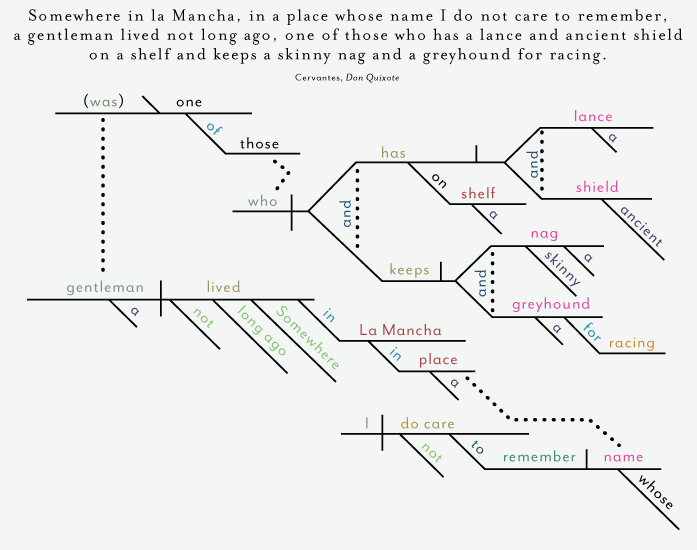
A book about diagramming sentences? How could that be anything but dry? Well, Sister Bernadette's Barking Dog, by Kitty Florey, is about diagramming sentences and is in fact quite entertaining!

For those of us who learned how to diagram sentences in school (say, anyone over the age of 50), Florey's book brings back memories (good or bad) of wrestling a sentence into that strange grid of lines. I enjoyed the practice, as did many others. Of course, some positively hated it, but even those readers would find this book a delight.

Florey begins with her own introduction to diagramming under the tutelage of Sister Bernadette, her sixth-grade teacher. The little nun's methods made the practice fun for her and other students in her class. She illustrates some of those methods with the type of sentence diagrams she and her classmates were asked to make. But once she entered high school, she laments, it was never mentioned again. She missed it, I think, as did I and other people in my age group who enjoyed taking a sentence apart and then putting it back together, only different. (Mwa ha ha!)

Kitty Florey
The book then goes on to present a history of sentence diagramming, which started back in 1860 with a book by S.W. Clark, Practical Grammar, that introduced balloon-shaped graphics to illustrate the different parts of a sentence. Then in 1877, the leaner, more efficient technique of using lines appeared in a book entitled Higher Lessons in English, by Brainerd Reed and Alonzo Kellogg. It became the bible of sentence diagramming and versions of it were used for decades to teach school children how to bring a sentence to heel.

The remainder of the book discusses the general rules of the practice, with lots of fun examples. There is an entire chapter in which Florey diagrams the sentences of famous writers, which I found quite entertaining. Those of you familiar with Henry James and his gargantuan sentences will especially enjoy the diagrams of his work.

She admits that diagramming sentences doesn't really help students write better or even better understand their language. That was the reason it was eventually abandoned as a general teaching method, after all. But sentence diagramming has made a comeback in recent years, though often for different reasons and with slightly different methods of illustration (tree diagrams, for one). Florey's book was published in 2006, but one can still find plenty of websites that explain and promote the practice.

Florey ends the book with a visit to a contemporary elementary school classroom where the students are learning sentence diagramming. The teacher tells Florey that she teaches diagramming not only to get a better grasp of how sentences are constructed, but also to have fun with words--because it is, after all, fun, especially if presented as a game. And this, Florey believes, is a very good reason for teachers to continue teaching it. As Florey says of her own experience, "Diagramming made language seem friendly, like a dog who doesn't bark, but, instead, trots over to greet you, wagging its tail" (154).

This was an entertaining and enlightening book. I recommend it highly!

Next on the "F" list: The Caregiving Dilemma, by Nancy Foner.

Sunday, April 9, 2017

Missing Someone? Call Rat Dog Dick!

Missing Persons: a writer's guide to finding the lost, the abducted and the escaped, by Fay Faron, was an entertaining and informative book. Part of The Howdunit Series, it is one of a group of books designed to describe the real work of detection in an effort to help murder mystery writers craft their characters and plots more authentically. This particular edition focuses on finding missing persons. The writer is a private investigator who owns an agency memorably titled, Rat Dog Dick Detective Agency. (She explains how she came up with that title in the book.)

Fay Faron
It was published in 1997, so some parts of the book were a bit dated, especially those sections where she outlines the sources of information for finding missing persons. The internet was still in its infancy then, so her research mainly involved using old-fashioned paper sources (egads!), face-to-face interviewing, and actual gumshoe-ing, or searching on foot. (For those of you who wonder, gumshoe refers to shoes that have gum soles and are therefore quiet.)

Despite the subject's being potentially grim, the writer's tone was light and her descriptions witty (what you'd expect from someone who named her agency Rat Dog Dick). Her list of the types of people she was hired to look for was very interesting. People are missing for a variety of reasons, some of them innocent, some not-so-innocent. When she first started looking for missing persons, her specialty was tracking down people who owed money to the court. Once she started her own company, she specialized in finding the missing, whatever the reason. She even worked with the Oprah show on a series of episodes helping people find lost relatives. But she refused to take some cases; if she thought she was going to get "stiffed, stuffed, or scalleywagged," as she put it, she steered clear.

Throughout the book, Faron illustrates her points with stories of some of her cases. They are very entertaining, especially the ones involving scoundrels, a type of missing person. (See the book for her chapter, "The Profile of the Scoundrel.") And not surprisingly, she is working on a mystery novel of her own. I had not heard of her before this, but I plan to check out her other writing.

All in all, a worthwhile read, even if you're not interested in writing mystery novels!

Next: Sister Bernadette's Barking Dog, a book about diagramming sentences by Kitty Burns Florey.

Thursday, April 6, 2017

At last! Murders!

Portreeve, SK - Prototype of Portreau, town in Canada
taken from Google Maps
Well, I enjoyed reading Canada, by Richard Ford, at least for a while, anyway. If you haven't read this book by now, I wouldn't recommend it, even though it got a glowing review in the New York Times when it first came out.

Right from the beginning, the narrator and also main character, Dell, kept hinting that there were going to be murders in the future. By the time I was two-thirds through the book, I was tired of hearing about those murders, and by the time the murders actually happened, almost at the end, I couldn't care less about the victims. In fact, I wanted to shout "Hallelujah!" when the poor fools were finally dispatched. Sad, I know.

The writer did a good job of developing the protagonist and even some of his fellow characters, but I think Ford broke the cardinal rule of fiction: never make your protagonist passive. As far as I could tell, Dell never did anything to make his situation better in all the time that he was suffering through it. He accepted mutely whatever he was told to do, even to the point of helping with the murders. Dell was a lot like his mother that way. The most active character in the book was Dell's bank robber father, who at least made decisions, even if they were usually the wrong ones.

I have to say that Dell did not deserve to get off with a good life after all he failed to do. The conclusion, therefore, was unsatisfying in a number of ways in that the baddest bad guy got away with murder--three times--and Dell failed to show any character. He wasn't even a very good story teller in that he built up the murder business so much it was anticlimactic when it finally came to pass.

The best part of the book was the description of the parents and what led up to the bank robbery. Once that was over, things were suspenseful for a time while we waited to learn what would be Dell's fate. But he started to get on my nerves when he wouldn't act and just kept going along. Perhaps he inherited that bad brain chemistry his parents seemed to display.

My next reading choice is another "F" book: Missing Persons: A Writer's Guide to Finding the Lost, the Abducted and the Escaped, by Fay Fanon. It's part of the Howdunit Series, books designed to help murder mystery writers with the various aspects of crime and detection. I own a few others in the series, but this will be the first one I've read.

Stay tuned!

Saturday, March 18, 2017

Champlain's Dream Ends

Taken from Montreal Rampage.com
Well, I finally finished Champlain's Dream. It was a very complete account, as far as I can tell, of the founding of New France. The latter half of the book was involved with Champlain's efforts to keep the new colonies going once they were established, part of which meant to navigate the often turbulent waters of French politics at the time, and to fend off the encroachments of the English who wished to take advantage of the resources the French territories had to offer.

Another change affecting New France was that the English as well as some of the French entrepreneurs were not interested in maintaining good relations with the native inhabitants and in fact were disrupting the patiently constructed inter-cultural affiliation that Champlain and his supporters believed was essential to the success of their colonial project. Selling alcohol and firearms to the Indians was lucrative for the traders but disastrous to the Indians. Moreover, the diseases that came along with each new wave of settlers were also devastating to the various groups of indigenous people who contracted them.

It's a pity that Champlain died, somewhat unexpectedly, at the time he did, in 1635. Had he lived a few more years he might have been able to see Quebec through the transitional period between kings, kept the English from taking Maine and other French held territory, and kept relations with and among the Indians peaceful. It's hard to say, however, whether that arrangement would have lasted much longer anyway with all the colonists' arriving and filling up the area with their farms and towns. Eventually, the Indians would have seemed to be encroaching rather than the other way around.

All in all, I enjoyed learning about this period in history, especially as it relates to my own family's history. I realized how little I knew about the founding of New France, and now appreciate the complexity of the events of the early years of the seventeenth century and the extraordinary character of the man who was largely responsible for making it all happen.

Richard Ford
Photo by Daniel Erath
Next on my list: Canada, by Richard Ford. I've never read anything by this author before, but I'm enjoying this novel quite a bit. It takes place in the 1960s and is a kind of coming-of-age story about a teenage boy, Dell, whose parents rob a bank, are caught, and go off to prison. What results from this calamity is the subject of the rest of the story. The book is quite well written and is keeping me in suspense, waiting to find out what happens to Dell. I'll let you know in the next post, so stay tuned!

Sunday, February 26, 2017

More of Champlain's Quebec

The only known depiction of Champlain:
a self portrait from one of his books
copied from Wikipedia
I did enjoy the Fleming book, The Perils of Peace. And continuing with the "F" authors, I'm now reading Champlain's Dream, by David Hackett Fischer. It tells the story of Champlain and his quest to start a French colony in the New World.

This is a very detailed book, and so is somewhat slow going, but the story is very interesting, particularly for me because one of my ancestors, Pierre Rancourt, immigrated to Quebec, the first permanent French colony in Canada, started by Champlain.

The adventures of the French settlers were at times quite harrowing, especially since it took them several tries before they succeeded in starting a permanent settlement. Many people died of diseases associated with starvation (scurvy, most often) and other mistakes such as eating bad meat.

This author seems to really like Champlain, and wants to refute some of the bad press Champlain has gotten over the years that accuses him of imperialistic actions, particularly against the natives of that region. He believes Champlain was different from the other French explorers in that he liked the Indians and wanted to live in peace with them. Certainly his ideas were different from other nations' colonial enterprises, especially the Spanish, who were the most ruthless in dealing with the Indians.

So far in the book, the colonists have survived their first winter at Quebec (later Quebec City), but just barely. This was 1608. My ancestor emigrated from France in 1633, I believe. So by that time the colony was well established, no doubt.

I'll be on this book for quite some time as it is very long and not a quick read. But I'm enjoying it so far.

Stay tuned for more insights into Champlain's quest.

Friday, December 9, 2016

We Haven't Changed

Gen. George Washington Resiging his Commission
painting by John Trumbull from Wikipedia
Well, I'm almost finished with The Perils of Peace, and I must say that it really opened my eyes to how messy democracy is. Far from smooth, the transition from British colony to independent collection of states was quite rocky, even--maybe especially--after the war was essentially over. The many different factions existing at that time made for a very complicated peace process that included not just Great Britain but also France, Spain, and the Netherlands, all of whom had a role to play in the U.S. obtaining their independence and ending the war against England.

Although the outcome was known from the beginning, the suspense of "Will America get her independence?" has made this book a very entertaining read. It has been at times a bit difficult to wade through, though, with trying to keep the names and positions straight of all the diplomats and government officials who were involved in negotiating the eventual treaty that gave us our independence as well as increased territory and fishing rights on the Grand Banks.

From this book I've gained quite a lot of awareness of as well as respect for the diplomatic function in government. These folks are quite brave and talented in navigating usually very turbulent waters to come up with what are sometimes brilliant agreements. What was also brought home to me is the necessity of compromise--each side giving up something to get something--in the establishment of any agreement. Very rarely, it would seem, does one side hold all the cards in a negotiation, and to hold out for everything when that stubborn position would prolong a war is unconscionable, in my opinion. This was brought home to France, England and America when it came time to set aside their most cherished desires and do what they needed to do to end a war that was emptying the coffers of all three nations.

For example, in hammering out the peace that gave America its independence, the U.S. wanted the British to compensate them for the property they destroyed during the war; the British wanted the Loyalists to be compensated for the property they gave up when the rebels confiscated it. The two countries agreed to add up the value of all the property on each side and whoever came out as being owed more would be paid by the other side.

What was especially interesting to me (and strangely comforting) is the realization that our congress was just as deeply divided back then as it is now and will always be, apparently, as that is what comes from putting together a nation composed of many sovereign states and expecting them to act in concert when they all have different, often competing interests. That we have managed that feat all these years, despite a civil war that threatened to destroy us, is testament to our belief (most of the time) that we are better together than we are apart. And I believe we will survive this latest chapter in our history as well because of our central pledge to uphold our brilliantly crafted and resilient constitution that binds us in our continuing quest to form a more perfect union.

I'm still reading this book, so stay tuned for my take on the aftermath of the Revolution.

Wednesday, November 23, 2016

After Yorktown


Thomas Fleming
Well, I got off on some tangents with library books the past several weeks, but now I'm back reading my own books. I finished the "D" category and decided to start on "F" authors, with a history of the American Revolution by Thomas Fleming, The Perils of Peace: America's Struggle for Survival after Yorktown. It's quite interesting. I didn't know anything about the immediate aftermath of the victory over Cornwallis in 1781.

Times in our fledgling republic were tough, apparently, with a lot going on. So far Fleming draws a very chaotic picture of people's response to the surrender of Cornwallis, some thinking the war was over, others trying to get the Army back together to continue the fight since the war was decidedly not over. George III was not conceding defeat and the new American government was out of money. It looks like this will be a good story.

Thursday, October 13, 2016

A Year of Pride

Thulani Davis, taken from UW website
My latest choice in the "D" category is a novel by Thulani Davis, 1959. It's a very interesting story that takes place in a small town in Virginia during 1959. The black residents of the town are confronting the changes coming with the civil rights movement that was then starting to gain momentum in the country.

It starts with the black residents of the town trying to get the schools to integrate in accordance with the Supreme Court decision Brown v. Board of Education, which took place in 1954. There is much resistance on the part of the white residents and officials, but the idea takes root in the minds of the black people who then start to think perhaps they should try to win other freedoms such as being able to eat in a Woolworth's lunchroom, or even to register to vote.

The people and the students of a nearby black college stage a sit-in which then leads to a boycott of white businesses and buses, including picketing the stores. There is much resistance and ugly, violent retaliation by the white people, who include law enforcement and the KKK. But the black people are undaunted and though they are beaten up and jailed and blocked at every turn, they don't quit and feel a renewed sense of pride at finally standing up for themselves.

The narrator is a twelve year old girl, who tells it from a future time when the strife of those days is past. So it's a young girl's perspective, but with the wiser understanding of an adult.

But it's not exclusively told from the girl's POV. Some of the events are told from the POV of several adults in the community. At least one of those characters was around during Reconstruction and provides a historical perspective that informs the events of the present time of the story. I often felt that part of the purpose of the novel was to inform readers--black as well as white--of what that time was like for people who lived in a place that didn't get any publicity.

It's a very well written book and I highly recommend it. I may also check out some of the author's other works.

Saturday, September 17, 2016

Doctorow's Picks

Taken from E.L. Doctorow
Well, I kind of got away from reading the "D" list for a while, but I got back to it with the annual anthology of short fiction, Best American Short Stories, the 2000 collection, edited by E.L. Doctorow. Doctorow, as some of you may know, wrote the famous book, Ragtime. The stories he selected for this volume were mostly enjoyable to read. Some were sweet and uplifting, others kind of depressing, but all were representative of the human condition.

The authors included were: Geoffrey Becker, Amy Bloom, Michael Byers, Ron Carlson, Raymond Carver, Kiana Davenport, Junot Diaz, Nathan Englander, Percival Everett, Tim Gautreaux, Allan Gurganus, Aleksander Hemon, Kathleen Hill, Ha Jin, Marilyn Krysl, Jhumpa Lahiri, Walter Mosley, ZZ Packer, Edith Pearlman, Annie Proulx, Frances Sherwood. Some of these writers were not as famous in 2000 as they would later become. Juno Diaz, for instance, is now well known and the winner of prestigious writing prizes, but in 2000 he had not yet produced a novel. A few others, however, have not gone further in their careers, despite early acclaim. One such writer is ZZ Packer, whose debut short story collection was highly praised. She continues to have difficulty following up that early success.

I read Ragtime and one other book by Mr. Doctorow. Both were very good. I was sad when he died last year from lung cancer.

Now on to the next "D" book, although I'm not sure yet which one it will be.

Wednesday, March 9, 2016

Five Books Considered; Three Make the Cut

I did finish Making Gray Gold and found it to be very informative and a little bit scary, especially when I got to the part where the author talks about how nursing homes make their money, treating care of the elderly as a commodity, using "beds" as shorthand for the people who were being cared for as if they were objects to be sold. This book was published more than twenty years ago; some things have gotten better, thanks to patients' rights advocates and changes to laws, but other things have stayed the same. And with the tsunami of baby-boomer elderly looming, it's likely that states will not be able to afford to care for those who need it. Those who sell these services may find that they've priced their customers out of the market. It's going to be interesting to see how this problem will be solved.

After that book, I began reading Jared Diamond's Pulitzer prize winner, Guns, Germs, and Steel, which was well received when it first came out in 1999. After a while, though, the book seemed a bit dated and perhaps just a tad too scholarly for a popular history, so I decided to let it go and moved on.

Granite Quarry
Next I turned to a couple of small volumes dealing with Deer Isle in Maine--both historical accounts. One is an Images of America: Deer Isle and Stonington, the other a history of granite quarrying in Stonington and other towns of the island, Stone Slabs and Iron Men. Both were interesting, especially the book about granite, since it contained more history than the other. I learned a lot that I didn't know about stone quarrying. It is much more complex and intensive than I had imagined. I gained more respect for those who did this work, especially before the introduction of powerful machines. Both books are worth reading.

Following the Deer Isle books, I turned to A Book of Common Prayer, a novel by Joan Didion, a famous writer of the 20th century. It started out interesting enough, but ultimately, the characters failed to elicit my sympathy. All seemed rich and whiny and deserving of their fates, so I put it down about half way through. I've never read any of her books before, but I know that she is popular among some readers, so if you are a fan, you will probably enjoy this book. As for me, I won't be returning to Ms. Didion's work.

Alexandre Dumas
Finally, I thought I'd check out a classic novel I'd never read but heard much about: The Count of Monte Cristo by Alexandre Dumas, who also wrote The Three Musketeers. Monte Cristo was published in serial format from 1844-1845 in France and later translated into English. The book has a historical backdrop: the post-Napoleon period in French history. It is already quite entertaining and that's a good thing, because at 783 pages, it's very long!

So, as you can see, though I haven't written here for more than a month, I've been very busy! Until next time, happy reading!